
During times of economic and market uncertainty, investors view gold as a stable store of value. If you are new to this asset class, or simply looking to better understand how gold works as an investment, this introduction provides a useful overview.
In the article, we’ll explore three key aspects of gold investing:
- Three factors that drive the price of gold.
- Gold’s role in a portfolio.
- How investors can gain exposure.
- The price of gold is influenced by economic crises, a weaker U.S. dollar, rising inflation expectations, and declining real interest rates. During economic uncertainty, investors perceive gold as a stable store of value.
- Gold is recognized as an effective way to safeguard against inflation. Where inflation erodes the value of your dollars, gold prices tend to outpace inflation over time.
- Gold and gold equities have historically moved in the opposite direction to other equities. Including gold in your portfolio can provide diversification, potentially offering stability and downside risk protection during turbulent economic conditions.
- You can gain exposure to gold by purchasing physical gold bullion directly, by buying stocks of gold companies, or investing in gold-focused mutual funds or exchange-traded funds (ETFs).
- Gold is like a safety net for investors. For a very long time, people have seen gold as a way to keep their wealth safe. To this day, some gold investors buy the physical gold bars or bullion and store it in secure vaults.
- In times of economic uncertainty, gold maintains its luster while other stocks and bonds may struggle. Since gold prices tend to work differently from those investments, gold and gold stocks can help you create a more diversified mix of investments. This can smooth out your investment experience and deliver returns if your other stocks and bonds are down.
- Gold can also protect investors from the impact of inflation. Historical data shows the price of gold tends to increase faster than inflation over time – helping you stay ahead of rising prices.
- stocks of gold mining companies
- a gold index (ETFs)
- gold futures contracts
- physical gold.
Gold prices continue to set all-time highs
Source: Bloomberg as of November 30, 2025. Gold prices in U.S. dollars (USD). Past performance is not a guarantee of future results.
Three factors that drive the price of gold.
1. Economic crisis
Gold is often viewed as a way to manage risk during periods of great market uncertainty. Generally, when investors start becoming fearful, they turn to ‘real assets’ like gold which are perceived to be a more stable and safe store of value. Gold is considered a real asset as it can be physically owned. Another example of a real asset is real estate.
Gold often performs well during an economic crisis
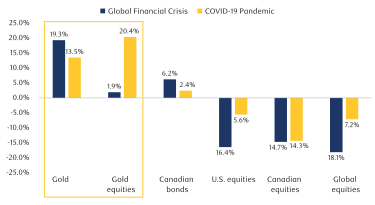
Source: Morningstar. COVID-19 returns are from February 19, 2020 to May 29, 2020. Global Financial Crisis returns are from December 31, 2007 to June 30, 2009. Gold represented by the S&P GSCI Gold Spot Index. Gold equities represented by the S&P/TSX Global Index. Canadian equities represented by the S&P/TSX Composite Total Return Index. U.S. equities represented by the S&P 500 Total Return Index. Global equities represented by the MSCI World Net Return Index. Canadian bonds represented by the FTSE Universe Canada Bond Index. Returns in Canadian dollars. An investment cannot be made directly into an index. Past performance is not a guarantee of future results. Returns in Canadian dollars.
2. Rising inflation expectations
Inflation is the rate at which goods and services increase in price over time. Rising costs mean your dollars will not go as far in the future as they do today – shrinking their purchasing power. Gold doesn’t have this problem.
We can see how gold protects your purchasing power by looking at the cost of bread in dollars and in gold over time. The cost of bread in dollars has only gone up, as the chart below shows. The cost of bread in terms of gold has gone down. Less gold buys the same amount of bread because gold prices have risen over time.
Over the long-term, gold has helped preserve purchasing power
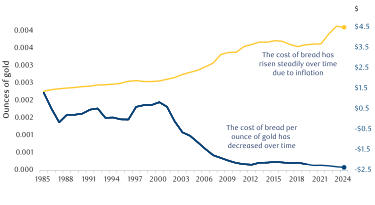
Source: Bloomberg, Statscan. Data as of December 31, 2024.
3. Declining real interest rates
Real interest rates are interest rates that have been adjusted for inflation. They show the true cost of borrowing or the actual interest you earn on your savings after factoring in the loss of purchasing power over time due to inflation. Gold prices tend to move in the opposite direction of real interest rates, meaning they have a negative correlation. As real interest rates fall, fixed income investments like bonds become less attractive as they offer lower returns for investors. This increases the demand for other investments – including gold.
Of course, declining real interest rates tend to coincide with an economic crisis. This is often a difficult time for equity markets too. With both equities and fixed income becoming less attractive, alternative assets like gold often shine.
Gold tends to move opposite to real interest rates
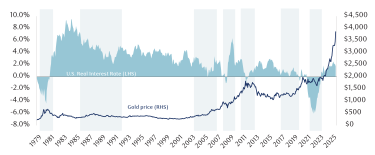
Source: Bloomberg, RBC GAM. Real interest rate calculated using U.S. 30-year government bond yields minus inflation. Gold prices in U.S. dollars. December 31, 1977 to September 30, 2025.
Gold in an investment portfolio
The price of gold and gold stocks can sometimes swing broadly from one day to the next. They tend to be less stable than bonds and other types of stocks. And, as you can see in the chart below, when gold is up, bonds and other equities tend to be lower. Likewise, when bonds and other equities are up, gold tends to be down.
For this reason, gold and gold equities can be used to help diversify an investment portfolio. They can provide stability when economic conditions deteriorate and stocks and bonds falter.
Gold tends to move opposite to traditional investments
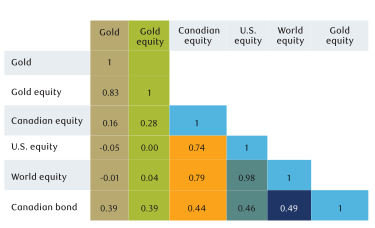
Source: Bloomberg 10-year correlations based on monthly returns in Canadian dollars as of November 30, 2025. Gold price reflected as spot price. Gold equities represented by the S&P/TSX Global Gold Index. Canadian equities represented by the S&P/TSX Composite Total Return Index. U.S. equities represented by the S&P 500 Total Return Index. Global equities represented by the MSCI World Net Return Index. Canadian bonds represented by the FTSE Universe Canada Bond Index. Correlation refers to the statistical relationship between two variables, indicating the degree to which they move in relation each other. Values range from -1 to +1, with 0 indicating no statistical relationship.
In an uncertain economic environment, diversification remains key to ensuring that your investment portfolio can withstand and perform under changing market conditions. Gold can play a role in achieving that diversification and help smooth out your returns.
In fact, historical data has shown that when stocks sell off, gold becomes more valuable – meaning gold has been most effective in a portfolio when diversification is needed the most.