
Key takeaways
- Cash is a risk-free place to keep your savings. It can provide security and stability.
- If you hold too much cash for too long, you may miss opportunities to earn greater gains from other investments.
- Dollar-cost averaging is a way to move your cash into the market in small amounts at a regular pace.
They say cash is king. It’s a safe place to park your savings that can earn you a guaranteed return. But for long-term investors, the charm of cash might be like an enchanting siren’s call, luring them off course.
How much might cash cost you as a long-term investor?
To illustrate the potential cost of cash, let’s imagine your goal is to save $500,000 over the next 20 years. We will compare two options to invest your savings:
- Hold your money in cash.We’ll assume that your money will grow at 1.7% each year. This is the 20-year rolling return of cash over the last 20 years.
- Invest in a balanced portfolio.We’ll assume that your money will grow at 6.7% each year. This is the 20-year rolling return of a balanced portfolio over the last 20 years.
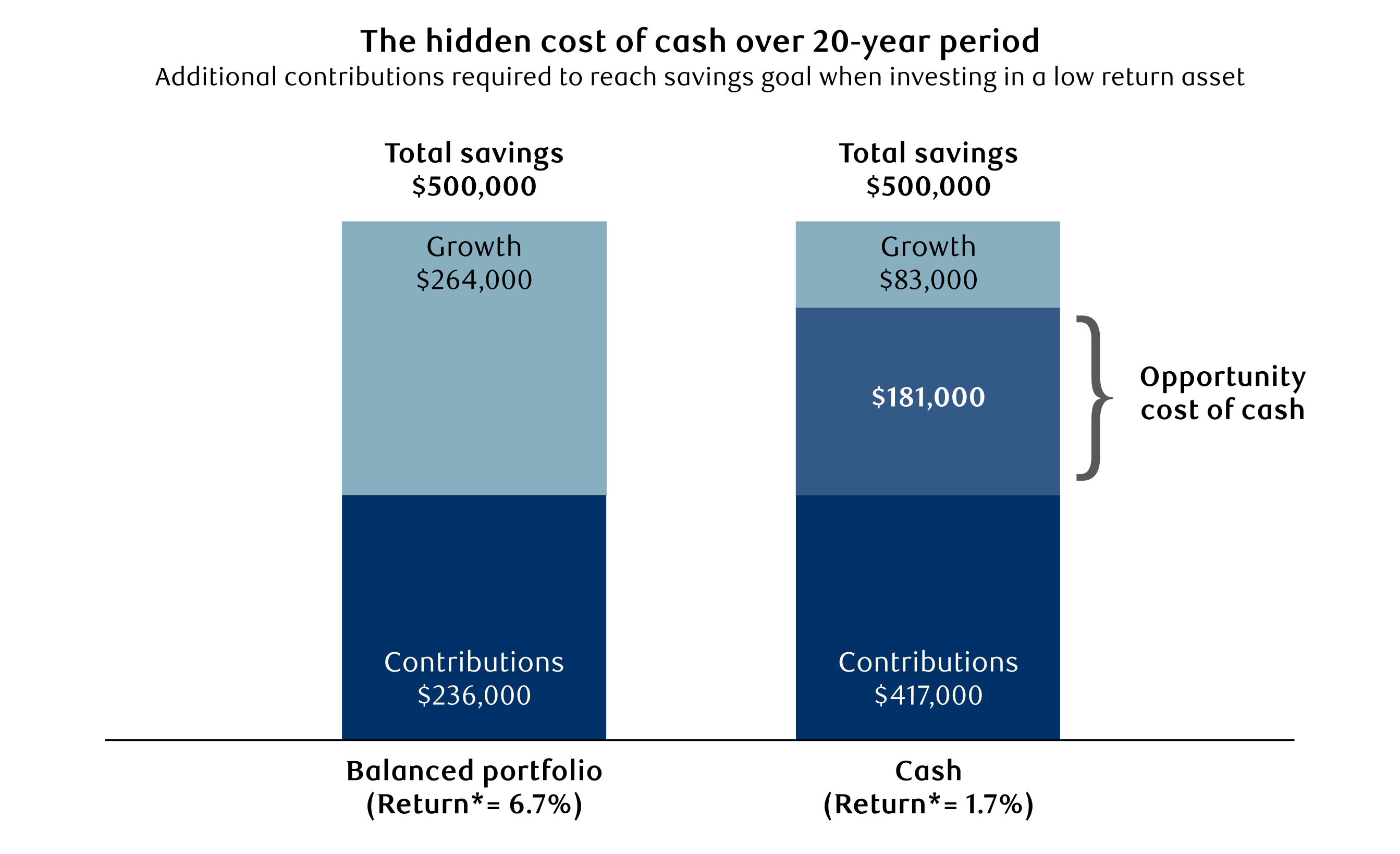
Source Bloomberg, RBC GAM. Scenario depicts the sum of equal annual contributions required over 20 years to achieve a total savings goal of $500,000, based on a constant return from a given investment. Dollar amounts are rounded to the nearest thousand. A Balanced Portfolio is represented by 2% Cash, 38% Fixed Income, 15% Canadian Equities, 25% U.S. Equities, 15% International Equities and 5% Emerging Market Equities. Cash is represented by FTSE Canada 30 DAY T-Bill Total Return Index, as of August 29; Fixed Income is represented by FTSE Canada Universe Bond Total Return Index; Canadian Equities is represented by S&P/TSX Composite Total Return Index; U.S. Equities is represented by S&P 500 Total Return Index; International Equities is represented by MSCI EAFE Net of Taxes Total Return Index; Emerging Markets Equities is represented by MSCI Emerging Markets Total Return Index. *All rolling returns are based off a 20-year period as of August 29th 2025. The above example is for illustrative purposes only and not indicative of any investment. Past performance is not indicative of future returns.
Based on our data, to reach your savings goals of $500,000:
- You would have contributed $417,000 over 20 years if you invested in cash investments such as GICs.
- You would have only contributed $236,000 over that same period if you invested in a balanced portfolio.
- Your hidden cost of cash is $181,000. This is because cash investments do not offer nearly as much return as a balanced portfolio. You would have to make larger contributions to reach your $500,000 savings goal.
While cash investments such as GICs are typically less risky than investing in balanced portfolios, you are giving up significant return potential by choosing to invest in the first over the second. In this example, an investor would have invested nearly 77% more in cash investments to achieve the same return as the balanced portfolio.
How can you put your cash to work?
If you’re ready to start investing but are waiting for the “perfect time” to do so, you may be doing more harm than good. There is no perfect time to invest and trying to time the market may cost you in the long run.
Dollar cost averaging (DCA) can be a better way to move from cash to the markets. This is where you invest a smaller amount at a regular pace, rather than making a larger lump-sum investment. DCA can help you gradually ease into the market, provides a smoother investment experience and puts your hard-earned cash to work.